Search This Blog

June 17, 2009

LA in one day

6:20am – landed in LAX Terminal 5.

7:00am – my friend picks me up in a silver Volkswagen Golf and drives me to the cozy motel where we crashed for two nights. The motel was in a very shady area of LA, but it had clean sheets and clean towels, plus cable TV. All I needed for my first weekend break in the city.

9:00am – we leave the motel in our great exploration of the fabulous city.

9:30am – passed the McDonald’s pancakes breakfast and the ride out of the ugly part of LA, we drive on Wilshire Blvd. by the great UCLA. There’re banners everywhere with extraordinary students which make you think if all of them (the students) will make it in life or steer at the uncertainty like many of us.

9:40am – we’re already on Sunset Blvd. where all the starts should shine. That Saturday, they were all hiding in the shade of their imperious residences. Still, I appreciated the clean neighborhood streets, the freshly cut green high fences, and the last generation hi-tech surveillance systems.

10:00am – we drive through Beverly Hills 90210. No Brenda or Brandon; though, the same houses style on both sides of the road.

10:50am – parked the car and begin walking on Hollywood Blvd. The smile from my face starts fading after the first 50 steps. Disgust appears along with reading tens of celebrities’ names under the golden/gray stars encrusted in the tiles of the sidewalk. Hope starts dyeing in front of the mall. One more wince at the glance of the Hollywood sign from the hills. And then…, in front of the tourism information center of the mall…, my LA heaven for tourists hope goes into cerebral death, when the associate shows me a map of the city with no attractions – just shopping places…

11:50am – start walking on Rodeo Dr. 20min into the promenade I have to express my disgust for splashy, exorbitant fashion. The Coach store looks by far the most acceptable. The only thing that totally impressed me: the fact that in an intersection you can get green light on all four corners and pedestrians can cross the street in any direction, including diagonal!

1:00pm – Pasadena, CA – “The city that feels like a village” – nice southern Californian combined with Mexican atmosphere, finally nice shops, kind ppl, lovely rose mosaics, good food, and the heaven of parking meters! This is one of the highlights of California: the genial solution for one thing I was wondering for ages - when will authorities implement parking meter credit card payment methods?!!? And… YES! they have it in Pasadena, CA. I love this place!

3:00pm – Venice Beach, CA. For a long time now seagulls have not been in my life on the beach… therefore this one was a remarkable encounter. The area… gave me chills.

8:00pm – Long Beach, CA (this time). One stop for a walk and an Italian dinner in the harbor where you can see the greatness of the city lights.

June 15, 2009

Eastern European School of Life

If you had the privilege to be born and raised somewhere in the East of Europe, in a former Communist or recent developing country, it doesn’t mean you are stigmatized for live, that you cannot understand the 1st Amendment of the US Constitution, or that you cannot understand what democracy means for “privileged” Westerns; it means you’ve learned a lesson more important for your existence – how to defend yourself wherever your steps might take you in no matter what frame of thinking!

Flashback: After traveling, living, and studying in 15 countries, in less than 4 years, I ended up on a Saturday night, in Señor Frogs, in Honolulu. Finally! After several months of hard work I got the chance to taste life, as a young student, for a few hours, with my friends.

Fine! The club was full of tourists and a few students re-experiencing the Waikiki night fun. We loved the place, we knew some waiters there, plus we felt like regulars, and we knew the place very well. We’ve got the table, some rounds of free drinks from our acquaintances, and we started dancing. Not for the first time, my purse was laying in the middle of the table and my roommate’s on a chair. Even if I never had a bad incident in US, I kept an eye on them, just in case. “Bad” habits never die… One of my buddies was getting friendly with some drinks – so, I considered him an extra protection for our ‘assets’. We were dancing right next to the table and there were not too many people close to it.

The plot: Because my buddy refused to dance (he is my favorite dance partner) I started to make fun and introduced some girls to him, so they could keep him company. Then I left... At one point, I realized that my friendly buddy was not at the table, and that my purse was not there anymore. I concluded that he hided it just to make me worry. I didn’t stress. When he came back I ask him to drop the joke, ‘cause I needed my phone. Of course he denied. I laugh. I checked everybody, I asked again, and things started to get serious. I realized it might not be a joke after all. My purse was missing for 5-10minutes.

In action: I told my waiter friend from Peru that my purse is missing. He assured me he will tell his colleagues. I didn’t see anything happening. I grabbed a cell phone and started to call myself. It was ringing! I went to Security. They all said they will take care of the problem. Only that I realized that nobody moved a finger. They were all preoccupied like the club was on a ticking bomb and my purse was the last thing on their minds. I kept calling myself. It was ringing and then going to my voice mail. My phone was somewhere. So, my purse was somewhere, too. I finally got to the chief of security – Mexican guy. He listened to my story: “It’s a black small purse. I have my ID, my cell, some money, my house and car keys in.” Nothing irrecoverable, but I wanted them back. I kept hearing in my mind: “You don’t steal from me! I’m from Romania! We invented the whole concept!!!” The chief of security called the chief of waiters – another Mexican. He heard my story, too. Said that he will inform his men. Hope was that somebody would bring my purse to Lost & Founds... But my phone is ringing!! He told me to send a message to my cell asking the person who took the purse to return it to Lost & Founds. Let’s do that, too! though… experience taught me is not the best idea… My phone was ringing!! I left them and I started to look around, on my own, under the tables and in garbage bins. It was a pretty funny image of this young lady, all fixed up, paying so much attention to the garbage in a club… and not even being drunk. Well…that was me, keep looking. At one point one of the handsome waiters saw what I was doing and approached me to make sure I am ok.

Here’s our conversation:

“Are you looking for something?”

“Yeah, my purse is missing, but my phone is still ringing!” (makes sense, isn’t it?!) I’ve got “the look” again, so I felt that I had to explain my logic: “My phone is in my purse and it is still ringing. You know? When you steal a cell phone…”

And here it is where he innocently said: “… I wouldn’t know…”

“Right! Well… I am from Europe and I know. When you steal a cell phone…, the first thing you do is to take the SIM card out. Or at least, you turn it off! Then when I would call it, it would go directly to the voice mail. Mine is ringing! That means the phone is still on, and it is somewhere!” I believe this is a perfectly Romanian logic…

So, I continued my search by looking into garbage bins, in Señor Frogs, in Honolulu… I went around the club, and when I finally looked into the bin next to the restroom… GOOOOOOLLLLDD! There it was!!! My pretty black purse, purchased in Madrid, Spain, in the winter of 2006, was reigning over the empty beer bottles and plastic cups in that garbage bin! I was looking for my purse for over 20 minutes, and it was still on top of the pop like it was just dropped… Inside there were my car and house keys, my cell phone, and my ID. No money. Whatevah! I considered I’ve been buying drinks on my account for some other people all night long. After all, my friends and I were having free drinks that night, too.


Happy end!

June 3, 2009

Chief Ali'i

Chief Ali’i Tour is not a very well advertised attraction. There are no brochures, no website, no ads in magazines or even guides. It has a good reputation especially among international tourists, only due to word-of-mouth. They say the tour is an authentic local experience and that it worth trying. Indeed, as soon as we got there – at the Macadamia Farm Outlet, up on Ka’a’awa, Oahu – we were nicely and warmly greeted in a truly Polynesian way, by young local men in malos that talk with a specific accent, and who invited us to a nice, free cup of Kona coffee, before the beginning of the tour.

This is a tour about the ancient Hawaiian culture, about the local agriculture, and about the modern preoccupations of the people that live and work there.

The white group (no joke!) embarked on a mini bus that use to be the star of “Jurassic Park” movie set and the driver turned up to be both the tour guide and the ‘chief’ of the “local village”. The bus ride started through the farms’ fields where he explained all fruits and vegetables that are traditionally planted in Hawai’i, answered all questions, and served some of the crops (macadamia nuts, star fruits, tangerines, guava, etc.). Next stop was at the “local village”. First, Chief Ali’i showed how locals used to make fire by using only two pieces of (same!) wood. Than, he demonstrated the multiple and total use of a coconut: the shredded body of the nut is used in alimentation, the juice and milk are drinkable, the husk helps starting fire, the nut can be decorated, and if the milk is left in the sun for a few days it transforms into coconut body oil. At the end, he performed a fire dance, and offered flowers (yellow hibiscus – the state flower of Hawai’i) to the ladies in the audience.

Next, the group was taken on a canoe on an ancient man made fishing pond where the tourists have the opportunity to see the Ko’olau mountains, the artificial island and the fields used as filming sets in different movies: “50 First Dates”, “Gilligan’s Island”, “Jurassic Park”, “E.R.”, “Lost”…

The tour ended with a last ride on the farm, some more fruit tasting, other stories, and Mahalo! (Thank you!). Everything was very intriguing because Chief Ali’i is able to give much agricultural and historical information, which seem accurate enough for an American tour. For tourists that come for the first time to the islands is a must – they get the chance to have an accelerate history/culture live class right on the spot at a reasonable price ($15/person).

Address:
49-227B Kamehameha Hwy.
Ka’a’awa, HI 96744
Phone: 808-781-2474

Hours of Operation:
Wed-Mon, 10:45 a.m. - 4:00 p.m. Tour begins every hour.

Tue, One tour only begins at 10:45 a.m.

June 2, 2009

DOLE

What does an American when he shuts down a farm (so he can move it to South America)?

He makes it a MUSEUM !

… The word for pineapple in Hawaiian is “halakahiki” which means “foreign fruit”. The pineapple is not even an indigene fruit of these islands. It is believed that it first originated in Paraguay or Brazil, and that it was introduced in Hawai’i by a Spanish shipwreck in 1527. But in time, the pineapple became the expression of hospitality and today, one of the symbols of the ‘rainbow state’.

James Dole – the “Pineapple King” arrived in Hawai’i in 1899 with 1,000$ to invest in horticulture, bought land in Wahiawa, O’ahu and started to grow pineapple. He wasn’t the first to do this here, but he certainly was the most successful and influential man who ever did it. Soon after he started to mass produce, he came up with the idea of packing and sealing the pineapple in cans, so that it can be exported on the international market.

From 1900-1990 in O’ahu, Hawai’i, USA functioned the most important pineapple plantation in the world, and in Honolulu the most profitable cannery ever (now, they do business in over 90 countries).

Later, when Globalization had a more heavy word in this business, too, and Dole saw the opportunity of moving the production to cheaper places – first form O’ahu to Lana’i (converting it from a cactus-covered island with 150 people into the largest pineapple plantation in the world with 20,000 pineapple-producing acres and over 1,000 pineapple workers), then from Hawaii to Latin America (Colombia and Ecuador), where labor force is much more cheaper.

The properties shrunk to the official buildings and some little land which were transformed in a tourist attraction. The main building on Dole plantation is today, an expensive souvenir shop where tourists can buy logo items and delicious pineapple based sweets (especially the world-famous DoleWhip). The court yard is divided in the part dedicated to the independent fruit vendors, and the one dedicated to the Dole Maze, to the Plantation Garden, and to the Pineapple Express.

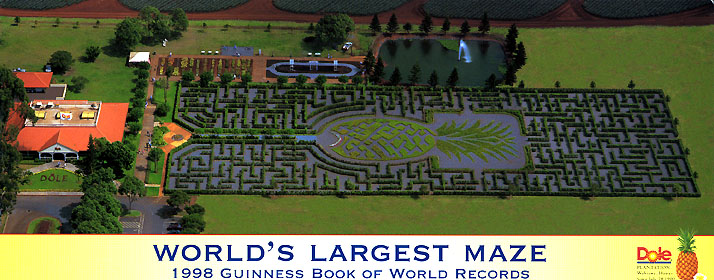
No 1 attraction of the Dole Plantation is the 2001 World Largest Maze (according to the Guinness Book of World Records) – about two acres with a path length of 1.7 miles of labyrinth! It is exciting when you think about it, but not so much when you actually get there… Unfortunately, the maze has no actual logic, or continuity, or organization; and this gave the owners the idea to invent a game, in order to keep attracting visitors, and to add value to their trip all the way to the middle of O’ahu. Well… you have to go through all bushes and find nine stations, then come back to the gate, and register your time. The record now is 6min (~ that person cheated for sure!). Fee: 3$

No 2 attraction is Pineapple Express – a two-mile, 20 minutes train ride on the fields. The good part of this short trip is that you get the chance to hear the history of the pineapple, of the agriculture in Hawai’i, of James Dole and his business. The bad/booooring part is that the train goes around some fields with plants in different stages of their cycle and abandoned tools once used for agriculture – nothing spectacular! More than that you have to pay a 7$ fee… it doesn’t seem a good deal for me…


No 3 attraction is the Plantation Garden – where tourists can learn, with the help of an audio guide (!!), about different native and traditional plants from Hawai’i (pineapple, bananas, coffee, cacao, mango, papaya, etc.). Fee: 4$.

Admirable is the fact that they’ve got innovative. The idea works, attracts tourists from all over the world, and it is enough for one time visits to reach profit. For tourists this is an opportunity to go deep into the island of O’ahu and get to know this beautiful area, too. It worth even if is not as spectacular as the rest of the places.

How to get there?

By TheBus: From Ala Moana Shopping Center take the bus 52 “Wahiawa-Circle Island” and get off at Dole Plantation. The bus ride takes 1-2 hours. Fare: $2 (ask for transfer to save money!)
By car: From Waikiki, take H1 West to H2 North. Continue to Kamehameha Highway (99). It takes approximately a 40 minute drive from Waikiki.

Dole Plantation is located at 64-1550 Kamehameha Highway, Wahiawa, island of O'ahu, Hawai'i, USA.
Phone: (808) 621-8408.
Web: www.dole-plantation.com
Hours: Daily, weather permitting: 9:00am–5:00pm;
Summer months: 9:00am–5:30pm.
Closed: Christmas Day.

June 1, 2009

Hanauma Bay


History:

The Hanauma Bay lies on the southeast shore of O’ahu, on an old crater which formed tens of thousand of years ago, through a volcanic eruption. In time, the waves and wind erosion forced one wall of the crated to fall and the crater was invaded by the ocean’s water. The current bay formed on top of the cooled lava, and today, at 10 mile from Honolulu, Hanauma is housing various types of marine life.

Formed from two Hawaiians words hana which means “bay”, and uma which means “curved”, Hanauma Bay attracts some 1 million visitors per year. They come there for the clear waters, for the large variety of tropical fish, for the beauty of the reef, and for the opportunity of encountering a sea turtle.

According to the official website of the city of Honolulu, the first time when Hanauma came into the public eye was in 1918, when a magazine presented the bay as an indicated place to stop for people traveling in those parts of the island. In 1929, the City and County of Honolulu start the long management of the area, after it bought it for one dollar from the Bernice Pauahi Bishop.

Through the years the management took some good and bad decisions which affected the bay indefinitely. In the 1950s the Hawaiian Telephone Company who was in charge of installing the trans-Pacific undersea telephone cable, blasted a wide swath through the reef, destroying the central portion forever. Unfortunately this was not seen as an ecological disaster at the time, but as a sacrifice for progress. In the 1960s Hanauma declared a Marine Life Conservation District. Fishing and any removal of any coral, rock, or sand was prohibited. In 1970s surfing activity was stopped in the bay. And the place became tourist oriented. In the 1980s the management enlarged the parking lot, thus the number of visitors reached 10,000/day. Those visitors, in order to make their activities in the bay more exciting started to feed the fish bread, peas, and snack. This attracted more and more fish into the area – fish that normally wouldn’t live there, that would endanger other species existence. The beach and water became overcrowded, because the commercial tours were monopolizing the area. The bay was suffocating.

Today, the bay is managed by the City and County of Honolulu on the part of Hanauma Bay Nature Preserve lying above the high tide line, and the State of Hawaii Dept. of Land and Natural Resources manages the underwater portion. And what they decided, after realizing the imminent danger of loosing one valuable natural resource, was to rebuild the ecosystem and to minimize the human impact for the future.


What we have learned so far:

  • Hanauma Bay is a natural preserved park, with spectacular natural resources.
  • Since 1929 it has been managed by the City and County of Honolulu.
  • During the 1980s the bay was heavily abuse by tourists and commercial operators’ supra exploitation – the number of visitors reached 3 millions/year.
  • In the 1990s the authorities started the environmental restoration of the bay.
  • From 1999 to 2002 Hanauma Bay was closed down for public, in order to leave the reef to come back to life in a natural way.
  • Today, the management takes serious measures towards protecting the natural habitat of the marine life in the bay: reduction of visitors number – every Tuesdays visitors access is closed, educational programs and one mandatory video which are teaching the tourists conservation, supportive restrictions – most commercial activities are banned, protection and preservation of the bay, tourists safety warnings, and volunteers who can attend in any moment to visitors.
  • Hanauma Bay Nature Preserve is about 10 miles east of Waikiki just off the main coastal road (Kalaniana'ole Highway, Route 72, Hawaii, USA)
The park is closed on Tuesdays.
Every second Saturday of the month tourists have the chance to snorkel at night.